Negative Gearing in Australia 2026: What the New Budget Rules Mean for Property Investors
10 Jun 2026
12 minutes
Loading...
Start Today
Join thousands of Australian property investors who save hours every month and never miss a tax deduction.
Have questions? We're here to help you get started.
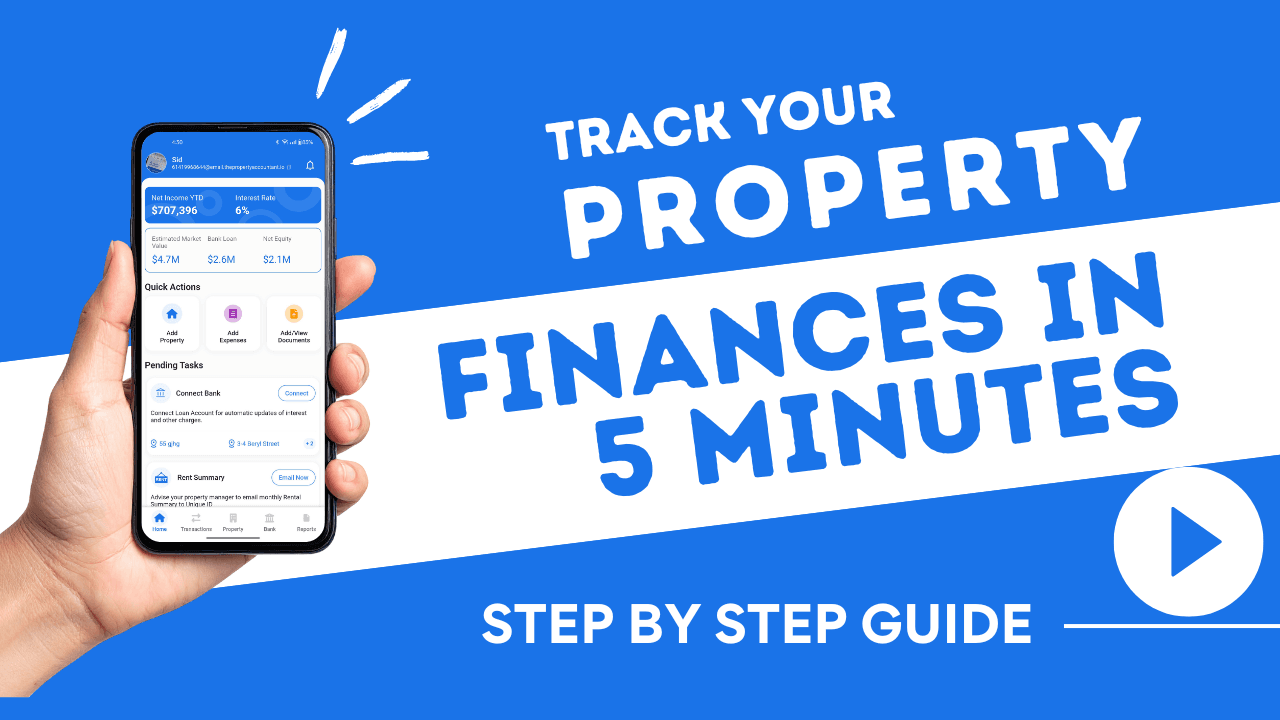
Watch the step-by-step guide and launch your automated workflow.
The Federal Government's 2026-27 Budget has changed the rules on negative gearing. The announcement was made on 12 May 2026 and the new rules kick in on 1 July 2027.
These are the biggest changes to property investor tax rules in almost 30 years.
This article explains what changed, what it means for you, and what you need to do - in plain, simple English.
Negative gearing simply means your rental property costs more to run than the rent it earns.
Here is a simple example:
| Item | Amount |
|---|---|
| Your rental income | $30,000 per year |
| Your loan interest + property costs | $45,000 per year |
| Your rental loss | $15,000 per year |
Under the old rules, that $15,000 loss could reduce your salary income - which lowered your tax bill.
| Item | Amount |
|---|---|
| Your salary | $120,000 |
| Less: your rental loss | − $15,000 |
| Taxable income | $105,000 |
So if your marginal tax rate is 45%, that $15,000 loss saves you $6,750 in tax. That is the tax benefit of negative gearing.
Under the new rules, this does not always work the same way anymore - and it depends on what type of property you own.
The simplest way to understand the changes is to put every property into one of three buckets.
| Bucket | Property type | What happens from 1 July 2027 |
|---|---|---|
| Bucket 1 ✅ | Properties you already owned before 7:30pm AEST on 12 May 2026 | Nothing changes. Your losses can still reduce your salary income. You are fully protected. |
| Bucket 2 🆕 | New builds - newly constructed homes that add to housing supply | Nothing changes. Losses can still reduce your salary income. |
| Bucket 3 ⚠️ | Established (existing) properties bought after 12 May 2026 | Your rental losses can no longer reduce your salary income from 1 July 2027. Losses are quarantined and carried forward. |
If you owned a property - or had a contract signed - before 7:30pm AEST on 12 May 2026, the old rules still apply to that property.
You can keep using your rental losses to reduce your salary income. Nothing changes for you.
If your property falls into Bucket 3 - an existing property bought after Budget night - your rental losses become what the ATO calls a quarantined loss.
That sounds complicated. Here is what it actually means:
OLD RULE: Rental loss → reduces your salary → you pay less tax this year.
NEW RULE: Rental loss → locked away → saved for future use against property income or when you sell.
The loss does not disappear. But the tax saving is delayed - sometimes for years.
James buys an established apartment in September 2026 for $650,000. He earns $120,000 salary.
From 1 July 2027, his property runs at a loss each year:
| Year | Rental loss | Can James reduce his salary? | Carried forward balance |
|---|---|---|---|
| 2027-28 | $15,000 | No ❌ | $15,000 |
| 2028-29 | $14,000 | No ❌ | $29,000 |
| 2029-30 | $13,000 | No ❌ | $42,000 |
At a 45% tax rate, James misses out on roughly $18,900 in tax savings over those three years - money he would have received under the old rules.
He gets the $42,000 loss eventually - but only when his property makes a profit, or when he sells. Not now when he needs it.
Compare that to Sarah, who buys a brand new townhouse in 2027. She can still use her rental losses against her salary - no delay, no quarantine. Same investment strategy, completely different tax outcome, just because of the property type.
This matters - because new builds keep the old negative gearing rules.
| Qualifies as a new build ✅ | Does NOT qualify ❌ |
|---|---|
| A newly built apartment bought off-the-plan | An existing house or apartment you buy second-hand |
| A duplex built on land where one house was knocked down (more homes = qualifies) | A knock-down rebuild replacing one house with one house |
| Any new home built on vacant land | A granny flat added next to an existing investment property |
| A newly built property occupied for less than 12 months before first sale | A new build lived in for more than 12 months before you buy it |
Important: Only the first buyer of a new build gets the benefit. If you buy a new build second-hand from someone else, you are back in Bucket 3.
The Budget also changed how capital gains tax (CGT) works when you sell a property. Here is the short version:
CGT is a big topic on its own - we have written a full explanation in our next article. Read: Capital Gains Tax Changes 2026 - What Property Investors Need to Know →
The rule change is important. But for most investors, the bigger risk is something else entirely.
Poor records
Here is the problem in one sentence: under the new rules, every dollar of rental loss must be tracked accurately - per property, per year - for potentially years into the future. And most investors are not set up to do that.
Let us put real numbers on what poor records actually cost:
Australian property investors commonly miss deductions that are sitting right in front of them. Here is what missed deductions cost at a 45% tax rate:
| Commonly missed deduction | Typical amount | Tax saving lost at 45% |
|---|---|---|
| Insurance paid directly by investor | $2,000/year | $900/year |
| Land tax | $3,500/year | $1,575/year |
| Loan package fees and charges | $500/year | $225/year |
| Repairs and maintenance invoices | $2,500/year | $1,125/year |
| Total across a typical portfolio | ~$8,500/year | ~$3,825/year lost |
That is nearly $4,000 a year in tax savings simply left on the table - not because the deductions were not allowed, but because the expenses were never properly recorded.
This is the mistake we see most often - and it is the most expensive one.
Many investors with Bucket 3 properties assume they do not need to do anything about rental losses until they sell, since negative gearing against salary is no longer allowed. They think: "I will claim all my losses when I eventually sell and make a profit."
That is wrong - and it can be very costly.
Here is why: the ATO only allows you to amend a tax return for up to 2 years after the original lodgement date. If you do not report your rental losses in the year they occurred, you may lose the right to claim them altogether.
An investor buys an established property in October 2026. From 1 July 2027, the property runs at a loss. He does not report the losses each year - he plans to claim everything when he sells.
Total losses accumulated: $61,000
When he sells in 2034 and tries to claim the $61,000 against his capital gain, his accountant discovers the 2-year amendment window has closed for Years 1, 2, and 3.
Years 1 + 2 + 3 losses ($42,000) are gone - cannot be claimed, cannot be amended.
At 45% tax rate, that is $18,900 in tax benefits permanently lost.
Years 4 + 5 ($19,000) can still be claimed - but only because they fall within the amendment window.
The losses were real. The deductions were legitimate. But because they were not reported each year, $18,900 is gone forever.
The rule is simple: every rental loss from a Bucket 3 property must be declared in your tax return in the year it occurs - even if you cannot use it against salary income right now. This is the only way to protect the loss for future use.
Loan interest is usually the biggest deduction for property investors. But deductibility depends on exactly how the loan funds are used - not what the bank calls the loan.
This becomes critical when investors refinance or use equity from one property to fund another.
Michael owns a property he bought in 2022 - a grandfathered Bucket 1 property with a $600,000 loan. Interest rate: 6%. Annual interest deduction: $36,000.
In 2027, Michael refinances and increases his loan to $1,000,000. He uses the extra $400,000 to buy an established investment property (Bucket 3).
Here is where it gets complicated:
The $400,000 × 6% = $24,000 in annual interest cannot reduce Michael's salary income. It must be carried forward as a quarantined loss - tracked separately from the Bucket 1 interest.
If Michael's accountant claims the full $60,000 interest against salary without splitting it correctly, that is a $24,000 overclaim. At 45%, that is $10,800 in tax incorrectly reduced.
The ATO will find this. Loan refinancing records are one of the first things reviewed in a property audit. Result: repayment of $10,800 in tax, plus interest and potential penalties.
The moment your loan funds multiple properties - or mixes investment and personal use - every cent must be allocated correctly. Without a proper system tracking each loan purpose from the day of the refinance, this is almost impossible to get right at tax time.
The ATO requires supporting evidence for every deduction. A number in a spreadsheet is not evidence.
This becomes a serious problem when carried forward losses are involved - because the ATO can ask you to prove every single year of losses at the point you claim them.
An investor accumulates carried forward losses over 5 years on her Bucket 3 property:
In 2032, she sells the property and claims the $100,000 loss against her capital gain. At 45%, that is $45,000 in tax relief.
The ATO reviews the claim and asks for supporting documentation for every year: rental statements, invoices and receipts for every expense claimed, loan statements showing interest charges, evidence of how loan funds were used.
The investor used a spreadsheet. Most of the 2027-28 invoices - including a $28,000 repair, contractor receipts, and several invoices - cannot be found.
The ATO disallows $40,000 of the Year 1 loss.
At 45% tax rate, that gap in documentation costs her $18,000 in additional tax, plus interest on the underpayment.
Five years of real losses. One missing folder. $18,000 gone.
The lesson: Every year of losses must be reported, and every year of losses must be documented - invoices, receipts, loan statements, rental records - and kept for as long as those losses remain in your carry forward pool. For a full list of what the ATO expects investors to keep: ATO rental property record-keeping guide →
Before the budget changes, a spreadsheet was inconvenient. After 1 July 2027, it is a genuine financial and audit risk. Every dollar of carried forward loss must be reported on time, documented with evidence, and tracked per property across multiple years. A spreadsheet cannot do that reliably.
A purpose-built platform like The Property Accountant is now an essential part of managing a residential investment property correctly under the new rules. Here is how the two approaches compare:
| ❌ Managing it yourself (spreadsheet + folders) | ✅ Using The Property Accountant |
|---|---|
| Rental statements manually re-entered each month - easy to miss income or expenses | Ask your property manager to send statements to your unique Property Accountant email ID - the platform reads it and records everything automatically |
| Loan interest tracked from bank statements - fees and charges routinely missed | Securely connect your bank via Open Banking - live feed from 100+ banks automatically imports up to 2 years of past transactions and keeps future ones current |
| Expenses paid directly (insurance, land tax, repairs) recorded from memory - often without invoices | Tap 'Add Expense', upload the invoice from your phone or web portal; AI reads it, simply review and save - stored, categorised, and attached to the right property immediately |
| Carried forward losses noted in old files - missed years, wrong amounts, lost at sale | Loss pool tracked automatically per property, per year - always visible to you and your accountant, with supporting invoices and documents attached. Always ready to claim |
| Tax time: weeks of chasing emails, document folders, and paper invoices - accountant lodges in September | One-click accountant access - they download everything instantly. Platform users typically lodge in July, not September |
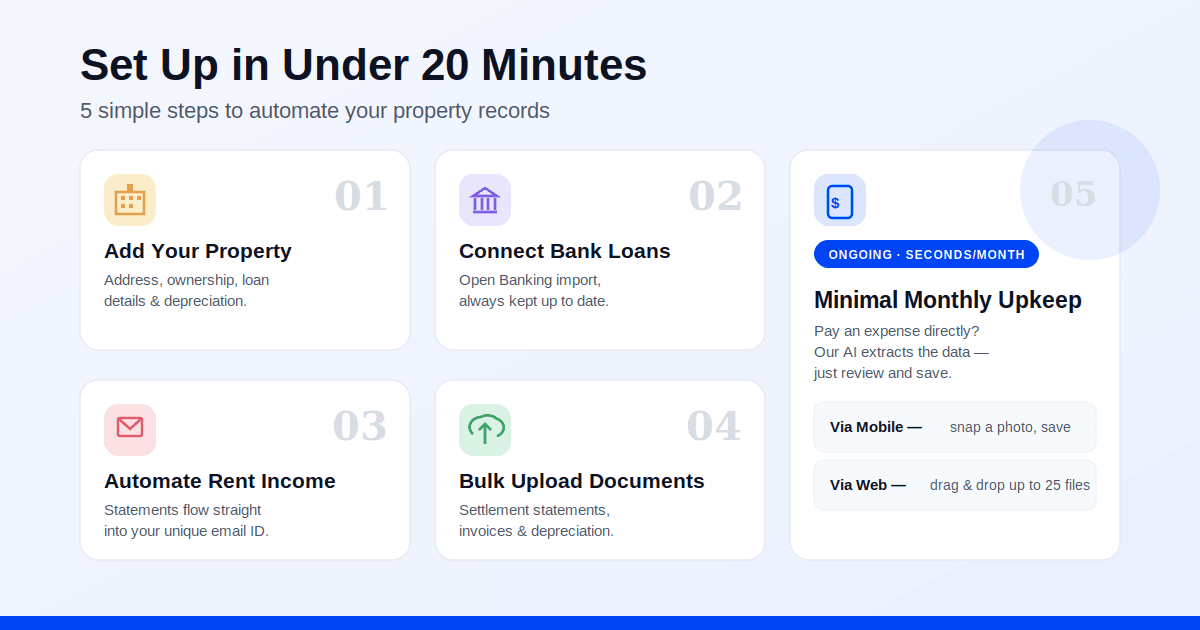
See it in action
Watch how the platform handles document uploads, expense tracking, and automated tax records - end to end.
The new rules start 1 July 2027. That gives you time to get organised - but not time to waste.
| Your situation | What to do now |
|---|---|
| You own properties bought before 12 May 2026 | You are protected - but get your records into a proper system now. The CGT transitional rules mean you will need accurate figures at 1 July 2027. |
| You are thinking of buying an established property | Losses will be quarantined from 1 July 2027. You must report them every year to protect them. Make sure your system can do that from day one. |
| You are thinking of buying a new build | Full negative gearing is available. Set up your records from settlement day - every deduction counts from the start. |
| You are planning to sell in the next few years | Talk to your accountant now about timing and how the CGT transitional rules affect your specific property. |
| You are still using a spreadsheet | This is the year to change. The new rules make accurate, annual records essential - not optional. A missed year of losses can cost you thousands permanently. |
Negative gearing still exists. It has not been abolished. But from 1 July 2027, it works differently depending on what type of property you own and when you bought it.
A spreadsheet records a claim. It does not protect it. Under the new rules, that difference matters more than ever.
Try The Property Accountant free for one month
Get Started Now →Disclaimer: This article is general information only and does not constitute personal tax advice. The negative gearing and CGT changes announced in the 2026-27 Federal Budget are subject to the passage of legislation. Individual circumstances vary - always speak with a registered tax agent before making investment or tax decisions.
From 1 July 2027, negative gearing for residential property will be limited to new builds only. Losses on established properties purchased after 12 May 2026 can no longer be offset against salary income - they must be carried forward against future property income.