Capital Gains Tax in Australia 2026: What the New Rules Mean for Property Investors
15 Jun 2026
15 minutes
Loading...
Start Today
Join thousands of Australian property investors who save hours every month and never miss a tax deduction.
Have questions? We're here to help you get started.
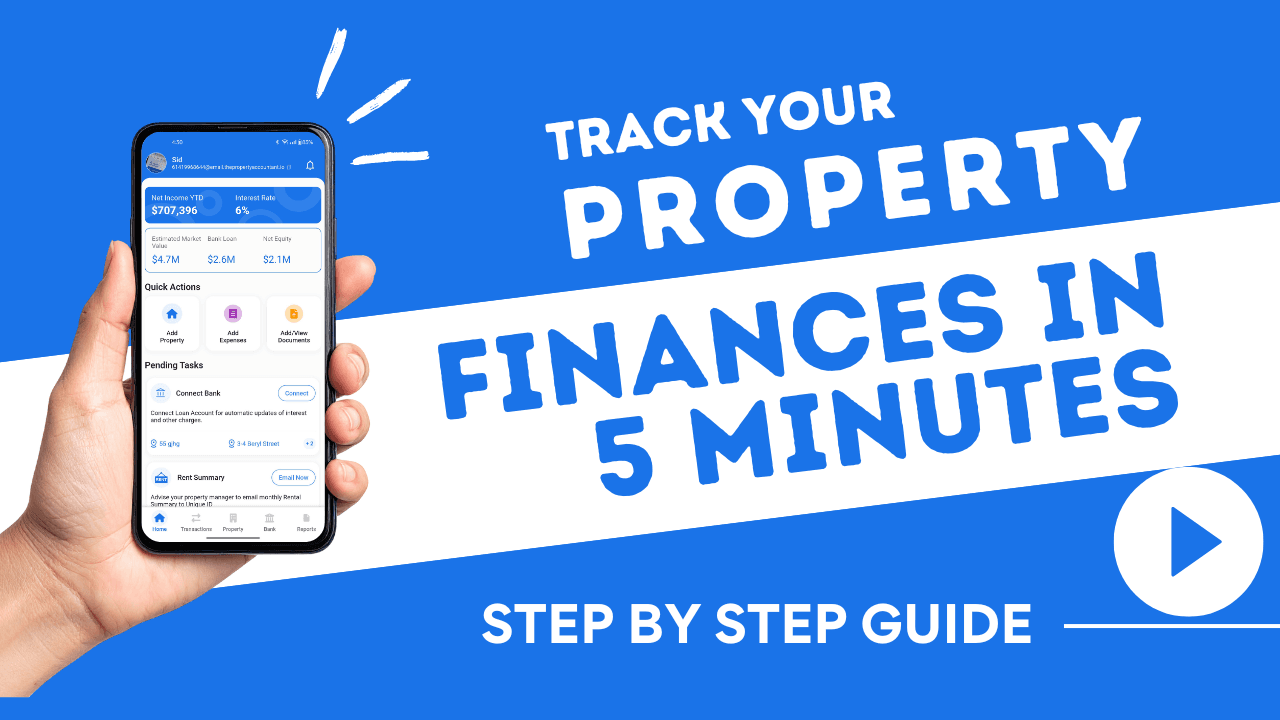
Watch the step-by-step guide and launch your automated workflow.
The Federal Government's 2026-27 Budget has changed how capital gains tax (CGT) works when you sell a property or other investment. The announcement was made on 12 May 2026 and the new rules apply to gains accruing from 1 July 2027.
These are the biggest changes to Australia's CGT rules since the 50% discount was introduced in 1999.
If you already own an investment property - particularly one purchased before 12 May 2026 - these changes affect you more than most. Your tax calculation will permanently split into two eras on 1 July 2027. How much you pay when you eventually sell will depend on decisions you make before that date: getting the right valuation, gathering your cost base documents, and making sure your records are complete. This article walks through exactly what you need to do.
Capital gains tax applies when you sell an asset - such as an investment property or shares - for more than you paid for it. The gain is added to your taxable income in the year you sell.
Here is a simple example:
| Item | Amount |
|---|---|
| You buy a property | $600,000 |
| You sell it 10 years later | $900,000 |
| Your capital gain | $300,000 |
Under the rules that applied since 1999, if you held the property for more than 12 months you got a 50% CGT discount. That meant you only paid tax on $150,000 of that $300,000 gain.
From 1 July 2027, the 50% discount is being replaced with a new system - and how much tax you pay will depend on how long you've held the asset, what return you've earned, and crucially, what records you keep.
The Budget makes three connected changes to CGT:
| Change | What it means |
|---|---|
| 1. No more 50% discount | The flat 50% CGT discount is gone for gains accruing after 1 July 2027. It still applies to gains made before that date. |
| 2. Cost base indexation returns | Instead of halving your gain with the 50% discount, you adjust your purchase price for inflation (CPI). Only the real gain above inflation is taxed. This only works if your records are complete. |
| 3. 30% minimum tax | Even if your marginal tax rate is lower (e.g. you've retired), a minimum 30% tax applies to capital gains. Exceptions exist for welfare recipients. |
If these sound complicated, do not worry. The rest of this article explains each one in plain English, with real examples.
The 50% CGT discount was introduced in 1999. It meant that if you held an asset for more than 12 months, you only paid tax on half the gain.
The government's view is that the discount was a blunt tool - it overcompensated some investors (those with high returns) and undercompensated others (those with modest returns). The new system tries to be more precise by only taxing the real gain above inflation.
Instead of cutting your gain in half, you now adjust your purchase price by the Consumer Price Index (CPI) - a measure of inflation. This effectively increases your cost base, reducing the taxable gain.
Here is how the maths works:
| Old 50% discount | New indexation method | |
|---|---|---|
| Purchase price | $500,000 | $500,000 |
| Sale price (10 years later) | $814,447 | $814,447 |
| Gross gain | $314,447 | $314,447 |
| Adjustment | 50% discount → taxable gain: $157,224 | CPI adjustment (2.5%/yr) → indexed cost base: $640,042 → taxable gain: $174,405 |
| Tax at 45% rate | $70,751 | $78,482 |
In this example - a 5% annual return with 2.5% inflation - the investor pays about $7,700 more in tax under the new system. Whether you pay more or less depends on your actual return vs. inflation.
💡 When do you pay LESS tax under the new rules?
If your return barely exceeds inflation, indexation strips most of the gain away - and your tax bill shrinks significantly. Lower-returning investors can actually benefit from the switch.
From 1 July 2027, a minimum 30% tax rate applies to capital gains. Here is why this matters.
Many investors plan to sell assets in retirement, when their taxable income is low. Under the old rules, if your income was low enough, you might pay only 15% or even 0% tax on a capital gain. The 30% minimum puts a floor on that.
| Situation | Minimum tax applies? |
|---|---|
| Your marginal rate on the gain is already 30%+ | No - minimum tax has no additional effect |
| You've retired, low income, marginal rate below 30% | Yes - tax tops up to 30% on the gain |
| You receive Age Pension, JobSeeker, or other income support in the year you sell | Exempt - minimum tax does not apply |
📊 Real example - the minimum tax in action
Jack has retired and earns $25,000 a year from a part-time role. In 2029-30 he sells an investment property and makes a $10,000 capital gain (after indexation).
At his marginal rate, the tax on the $10,000 gain is $1,400 - a tax rate of just 14%. Because this is below 30%, Jack pays an additional $1,600 to bring his rate up to 30%.
Had Jack been receiving the Age Pension, he would have been exempt from the minimum tax entirely.
Just like negative gearing, the simplest way to understand the CGT changes is to put every asset into one of three buckets.
| Bucket | Asset type | CGT treatment when you sell |
|---|---|---|
| Bucket 1 ✅ | Assets purchased AND sold before 1 July 2027 | No change at all. Old 50% discount applies in full. |
| Bucket 2 ⏳ | Assets purchased before 1 July 2027, sold after | Split treatment. Old rules for gains up to 1 July 2027. New indexation + 30% minimum for gains after that date. |
| Bucket 3 ⚠️ | Assets purchased from 1 July 2027 | New rules apply in full: indexation only, no 50% discount, 30% minimum tax. |
If you own a property today, the gains you've already made up to 1 July 2027 are still taxed under the old 50% discount. You are not being taxed retrospectively. Only gains that accrue after that date use the new method.
For investors who owned assets before 1 July 2027 and sell after, the gain must be calculated in two separate phases - each with different rules. Add a capital renovation on top of that, and the calculation has multiple moving parts.
The example below follows a single property through every step, so you can see exactly how the layers interact.
| Event | Detail |
|---|---|
| Purchase date | 1 January 2020 |
| Purchase price (cost base) | $800,000 |
| Market value at 1 July 2027 (certified valuation) | $1,200,000 |
| Capital renovation (September 2029) | $200,000 |
| Sale price | $1,800,000 (June 2032) |
| Inflation assumption (post-2027) | 2.5% per year (CPI), compounded. Applied over 5 years on the 2027 base value = 13.1% cumulative. Applied over 2 years 9 months on the 2029 renovation = 7% cumulative. |
For the growth up to the cutoff date, the old 50% discount applies.
| Step | Calculation | Result |
|---|---|---|
| Market value at 1 July 2027 | Certified valuation | $1,200,000 |
| Less: original purchase price | $1,200,000 − $800,000 | = $400,000 gross gain |
| Apply 50% CGT discount | $400,000 × 50% | = $200,000 taxable |
| Phase 1 taxable gain | $200,000 |
For the growth after the cutoff date, the 50% discount is off. The cost base resets to the 1 July 2027 value and is indexed for inflation. The 2029 renovation is also indexed from the date it was spent.
| Step | Calculation | Result |
|---|---|---|
| Reset cost base (1 July 2027 value) | Certified valuation | $1,200,000 |
| Index base for inflation (2.5%/yr compounded over 5 years = 13.1% cumulative) | $1,200,000 × 1.1314 | = $1,357,700 indexed base |
| Add: renovation cost, indexed for inflation (2.5%/yr compounded over 2 yrs 9 mths = 7% cumulative) | $200,000 × 1.07 | = $214,000 indexed renovation |
| Total indexed cost base (Phase 2) | $1,357,700 + $214,000 | = $1,571,700 |
| Sale price | June 2032 | $1,800,000 |
| Phase 2 taxable gain | $1,800,000 − $1,571,700 | $228,300 |
| Component | Amount |
|---|---|
| Phase 1 taxable gain (50% discount applied) | $200,000 |
| Phase 2 taxable gain (indexation applied) | $228,300 |
| Total combined taxable gain | $428,300 |
| Tax at 45% marginal rate | $192,700 |
The key takeaway: high-returning assets held for long periods after 1 July 2027 will attract more tax under the new system. Modest-returning assets may actually attract less. And the renovation - properly documented and indexed from the date it was spent - reduces the Phase 2 gain by $14,000 simply because inflation is applied to it.
This is the single most costly mistake an investor in Bucket 2 can make. And it is surprisingly easy to miss.
If you do not get a certified, in-person valuation of your property on or around 1 July 2027, the ATO requires you to use the ATO Apportionment Formula - which averages your total growth evenly across your entire ownership period, based on the number of days held before and after the cutoff. A retrospective valuation done by an ATO-approved valuer after the fact may still be accepted in some circumstances, but it will typically produce a lower estimate than an inspection done at the time - and any uncertainty is resolved in the ATO's favour.
The problem is that real estate does not grow in a straight line. If your property grew quickly between 2020 and 2027 but more slowly after that, the formula artificially smooths the history - lowering your 1 July 2027 baseline, shrinking your tax-free buffer, and pushing more of your gain into the new (higher-taxed) era.
Here is what that costs, in real dollars.
| Step | Scenario A: No valuation (ATO default formula) | Scenario B: Certified valuation | What this means |
|---|---|---|---|
| Original purchase price (2020) | $800,000 | $800,000 | Both scenarios start identically. |
| 1 July 2027 baseline value | $1,000,000 (formula average) | $1,200,000 (true market value) | A uses a straight-line average. B locks in the real value. |
| Phase 1 gross gain | $1,000,000 − $800,000 = $200,000 | $1,200,000 − $800,000 = $400,000 | A has less growth in Phase 1, where the 50% discount applies. |
| Phase 1 taxable (50% discount) | $100,000 | $200,000 | A's discount is applied to a smaller base. |
| Phase 2 inflation buffer (13.1% cumulative CPI, compounded) | $1,000,000 × 1.1314 = $1,131,400 indexed base | $1,200,000 × 1.1314 = $1,357,700 indexed base | A lower baseline means a smaller inflation buffer - $226,300 less protection. |
| Renovation cost indexed (7% cumulative, compounded) | $200,000 × 1.07 = $214,000 | $200,000 × 1.07 = $214,000 | Same in both scenarios - renovation records are identical. |
| Total Phase 2 indexed cost base | $1,131,400 + $214,000 = $1,345,400 | $1,357,700 + $214,000 = $1,571,700 | A's total tax-free buffer is $226,300 smaller. |
| Phase 2 taxable gain | $1,800,000 − $1,345,400 = $454,600 | $1,800,000 − $1,571,700 = $228,300 | A pays tax on $226,300 more than B. |
| Total combined taxable gain | $100,000 + $454,600 = $554,600 | $200,000 + $228,300 = $428,300 | $126,300 difference in taxable gain. |
| Final tax bill at 47% | $554,600 × 47% = $260,700 | $428,300 × 47% = $201,300 |
⚠️ The cash difference: $59,400
Skipping the 1 July 2027 certified valuation costs this investor $59,400 in extra tax - on the same property, the same renovation, and the same sale price. The only difference is one document, obtained at the right time.
Investors in new residential builds get a concession that other investors do not: they can choose which CGT method gives them the better result when they sell.
| Option A: Old 50% discount | Option B: New indexation + 30% min tax |
|---|---|
| Better if you've earned high nominal returns and held for a shorter time | Better if inflation has been high or your real return above inflation is modest |
Your accountant can model this at sale time and pick the better option. This flexibility is only available to the first purchaser of a new build. If you buy a new build second-hand, you lose this choice.
Note: The definition of a new build for CGT purposes aligns with the negative gearing rules - a newly constructed dwelling on vacant land, or a knock-down rebuild that increases the number of dwellings on the site.
The rule change matters. But for most investors, the bigger risk is something else entirely.
Poor records
The worked example above shows exactly why: a $59,400 tax difference from one missing valuation. Under the new rules, the ATO needs to verify the cost base of your asset at 1 July 2027, every capital improvement, and every deduction claimed across years - all supported by invoices, receipts, and formal documentation. Most investors are not set up to prove any of it.
Here are the five record-keeping risks that now matter most.
As the example above shows, this is the most expensive single mistake. You must get an in-person valuation from a certified, registered property valuer on or around 1 July 2027. Online estimates and agent appraisals do not qualify.
If you already own investment properties, the date to prepare for is now. The window to do this correctly is narrow - and the valuation must be done at the time, not reconstructed later.
Your cost base is not just the purchase price. It includes a range of costs that investors routinely miss - and every dollar missed increases your taxable gain.
| Commonly missed cost base item | Typical amount | Tax saving lost at 45% |
|---|---|---|
| Stamp duty (often overlooked in cost base) | $20,000-$35,000 | $9,000-$15,750 |
| Legal / conveyancing fees at purchase | $1,500-$2,500 | $675-$1,125 |
| Building and pest inspection fees | $500-$900 | $225-$405 |
| Capital improvements (kitchen, bathroom, etc.) | $15,000-$50,000+ | $6,750-$22,500+ |
| Selling costs (agent commission, legal, marketing) | $12,000-$25,000 | $5,400-$11,250 |
Under indexation, every dollar added to your cost base also grows with inflation - meaning the upside of a complete cost base compounds over time. A $20,000 stamp duty correctly recorded today, indexed at 2.5% per year over five years, saves you $22,400 from your taxable gain at sale.
Capital improvements are one of the biggest missed deductions in CGT calculations - and one of the hardest to reconstruct after the fact.
Under the new rules, the stakes are higher. A renovation invoice is not just a deduction - it is also an indexation multiplier. A $200,000 renovation properly recorded and indexed reduces your taxable gain by $214,000, not $200,000. A missing receipt loses both the base cost and the inflation adjustment on top.
An investor spent $60,000 on capital improvements over 8 years: a new bathroom ($18,000), new kitchen ($22,000), and landscaping ($20,000). When she sells, the ATO asks for supporting invoices and receipts for every item.
She can find the kitchen receipts. The bathroom contractor has retired. The landscaping was paid in cash. The ATO accepts $22,000 and disallows $38,000.
At 45%, that documentation gap costs $17,100 in extra tax - before indexation. With the inflation adjustment also lost on the disallowed amounts, the real cost is higher.
Capital works deductions (building depreciation) claimed during your ownership reduce your cost base dollar for dollar - and the ATO requires this adjustment whether you remember it or not.
For example: if you have claimed $30,000 in capital works depreciation over the years you owned the property, your cost base must be reduced by $30,000 when you calculate your CGT. Miss it and you are understating your taxable gain. The ATO will find the discrepancy by cross-referencing your prior year returns.
Under indexation, this interaction matters even more. A lower cost base means less to index - which means a smaller inflation buffer and a higher taxable gain. Getting the depreciation clawback wrong does not just affect the base calculation; it ripples through every layer of the Phase 2 maths.
Many investors get a depreciation schedule done and assume that covers them at sale time. It does not - and the gap between what they assume and what the ATO requires can be very costly.
Here is the problem: a depreciation schedule tells you what you can claim each year. It does not automatically add the underlying improvement cost to your cost base. Those are two separate records that must both exist and be linked.
If you spent $50,000 on a new kitchen and had it depreciated, but never recorded that $50,000 as a capital improvement in your cost base, you face a double hit at sale time: the ATO reduces your cost base for the depreciation claimed, but you get no credit for the capital improvement itself. The result is a higher taxable gain than you should legally owe - and one that compounds under indexation over time.
The fix is simple in principle: keep the original improvement invoice and the depreciation schedule together, linked to the same property. In practice, most investors store them in different places - or cannot find the invoice years later when it matters.
Before the budget changes, a spreadsheet was inconvenient. After 1 July 2027, it is a genuine financial and audit risk.
The calculations shown above - Phase 1 gains, Phase 2 indexed cost bases, renovation indexation, depreciation clawbacks, improvement cost tracking, the split-date valuation - are not things a spreadsheet can reliably hold together over a 10-year ownership period. One typo in a CPI formula, one misfiled invoice, one missed depreciation entry: any of these can change your final tax bill by tens of thousands of dollars.
A purpose-built platform like The Property Accountant is now an essential part of managing a residential investment property correctly under the new rules. Here is how the two approaches compare:
| ❌ Managing it yourself (spreadsheet + folders) | ✅ Using The Property Accountant |
|---|---|
| Settlement documents stored in email or a physical folder - easy to lose over a 10-year hold | Upload your settlement statement once at setup. Stored against your property permanently, ready for CGT calculations whenever you need it. |
| Capital improvements tracked from memory - invoices from years ago frequently cannot be found | Upload invoices from your phone or web portal as you go. AI reads and categorises them. Stored, attached to the right property, permanently. |
| CPI indexation calculated manually from ATO tables - one formula error changes your entire tax position | Inflation indexation calculated automatically using real-time ATO CPI data. No manual lookup, no formula risk. |
| Depreciation schedule filed away and forgotten - interaction with cost base missed at sale | Depreciation schedule uploaded at setup. Platform links it directly to your improvement costs and cost base, so the interaction is tracked automatically. |
| Split-date value calculated at sale time from incomplete records - errors are common and costly | Complete purchase and improvement records mean your accountant can accurately calculate CGT across all layers - Phase 1 discount, Phase 2 indexation, depreciation interaction - to minimise your overall tax bill. |
| Tax time: weeks of chasing documents. Accountant lodges in September. | One-click accountant access - everything downloaded instantly. Platform users typically lodge in July, not September. |
See it in action
Watch how the platform handles document uploads, expense tracking, and automated tax records - end to end.
The new rules start 1 July 2027. That gives you time to get organised - but not time to waste.
For investors who already own property, the single most time-sensitive task is securing the right valuation. The Property Accountant connects you directly with a panel of certified, ATO-approved property valuers - so you can arrange the 1 July 2027 valuation in one place, with confidence that it meets the ATO's requirements. Everything else - your cost base records, improvement invoices, depreciation schedule - can be uploaded and tracked on the platform from day one.
| Your situation | What to do now |
|---|---|
| You own properties bought before 12 May 2026 | Start getting your records in order now - settlement statements, improvement invoices, depreciation schedules. Book your certified 1 July 2027 valuation closer to the date through our panel of approved valuers. The window to do this correctly is narrow. |
| You are thinking of buying a new build | You get to choose between old and new CGT methods at sale - whichever gives you the lower tax bill. The Property Accountant can model both options using your actual records and help you and your accountant pick the better one at sale time. |
| You plan to sell in the next few years | Talk to your accountant now about timing. Selling before 1 July 2027 means the full 50% discount applies. Selling after means you need a certified split-date valuation and complete cost base records. |
| You plan to retire and sell assets when income is low | Model the 30% minimum tax now. Depending on your income in retirement, it may significantly affect how much you keep from a sale. Get your records in order before that conversation with your accountant. |
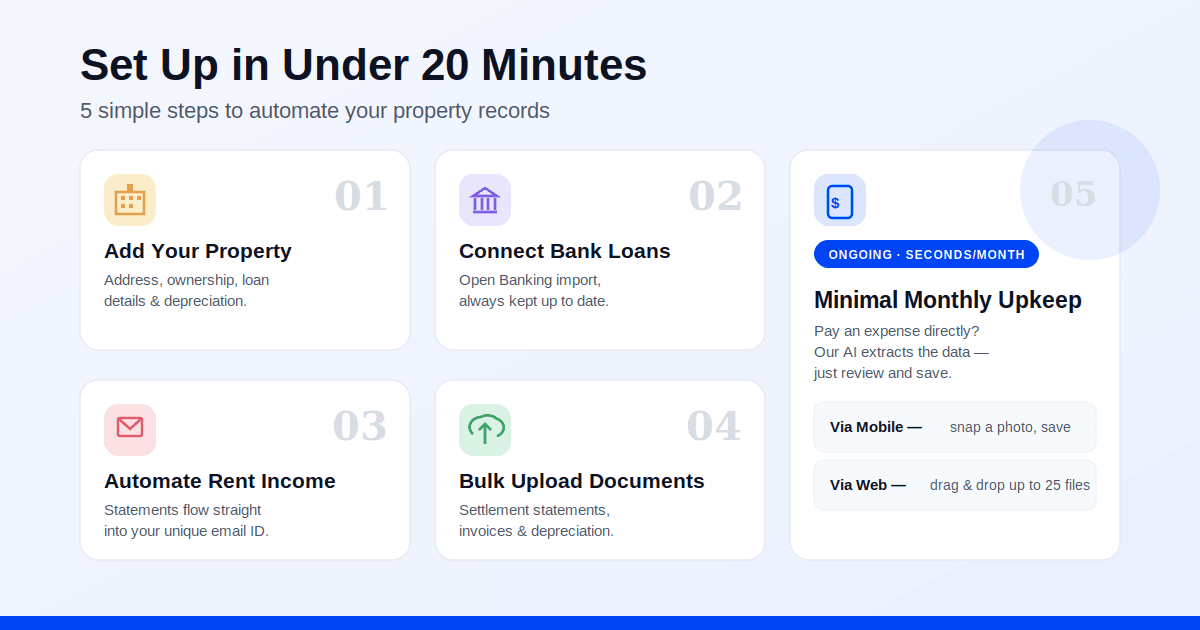
| You are still using a spreadsheet | This is the year to change. Sign up for The Property Accountant, upload your documents, and connect your bank - in under 20 minutes you'll have a system that protects your records, tracks your cost base, and keeps you audit-ready for years to come. |
The 50% CGT discount is going. But the change is not as simple as 'you will pay more tax' - it depends entirely on your return, how long you hold the asset, whether you get the right valuation at the right time, and how complete your records are.
A spreadsheet records a number. It does not protect a claim. Under the new rules, that difference matters more than ever.
Try The Property Accountant free for one month
Get Started Now →Disclaimer: This article is general information only and does not constitute personal tax advice. The capital gains tax changes announced in the 2026-27 Federal Budget are subject to the passage of legislation. Individual circumstances vary - always speak with a registered tax agent before making investment or tax decisions.
From 1 July 2027, the 50% CGT discount for individuals is being replaced with two new measures: cost base indexation (adjusting your purchase price for CPI inflation, so only real gains above inflation are taxed) and a 30% minimum tax on capital gains. If you owned an investment property before 1 July 2027, your gain will be split into two parts: gains up to 1 July 2027 are still taxed under the old 50% discount, and gains after that date use the new indexation method.